
10 Essential Elements of a High-Converting Website
- Reading Time : 10 min
- Category : Outbound System
- Updated Date : 17-08-2026
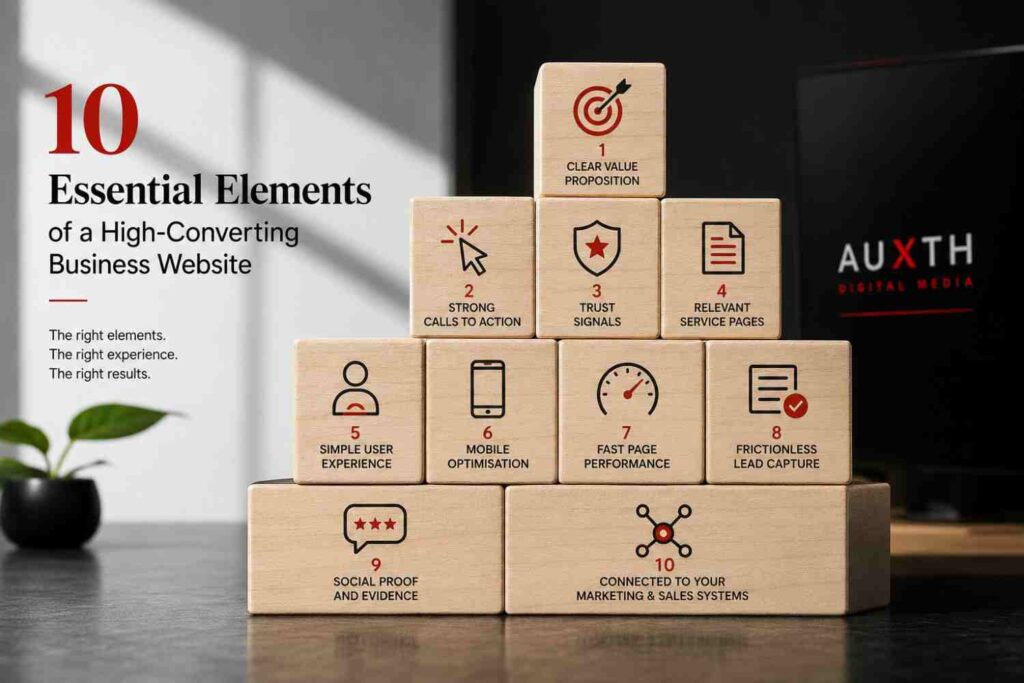
Table Of Content
- Essential elements of a high converting website
- Glance at ten elements
- These Elements Work Better Together
- Don’t Optimise One Element in Isolation
- Final Thoughts
Introduction
A business website has one job that is often overlooked: helping visitors move toward a decision. It is easy to judge a website by how it looks. A modern design, attractive imagery, smooth animations, and professional branding can certainly create a strong first impression. But none of these things automatically turn visitors into customers.
A high-converting website combines design with strategy. It makes the business easy to understand, establishes credibility, answers important questions, removes unnecessary friction, and gives visitors a clear next step.
Whether your website is generating traffic through SEO, Google Ads, social media, referrals, or direct searches, these ten elements can determine how effectively that traffic becomes real business opportunities.
1. A Clear Value Proposition
Visitors should understand what your business offers almost immediately. Your headline and supporting message should communicate what you do, who you help, and the outcome customers can expect. If visitors have to read several sections before understanding your value, the website is making them work too hard.
A clear value proposition creates immediate context. It helps the right visitors recognise that they are in the right place and encourages them to continue exploring.
2. Strong, Relevant Calls to Action
A website should never leave visitors wondering what they are supposed to do next. Your primary call to action should be visible, understandable, and connected to the visitor’s stage in the buying journey. Depending on the business, this could be booking a consultation, requesting a quote, starting a project, purchasing a service, or contacting the team.
The important point is consistency. Your calls to action should guide visitors rather than compete with one another.
3. Trust Signals
Even when visitors understand your offer, they may still hesitate. Trust signals help reduce that uncertainty. Testimonials, reviews, case studies, certifications, client results, guarantees, industry experience, and clear company information can all demonstrate credibility.
Trust is particularly important for businesses selling higher-value services because visitors are not simply evaluating what you offer. They are evaluating whether they can confidently choose you.
4. Relevant Service Pages
A single homepage cannot answer every question a potential customer has. Dedicated service pages allow you to explain specific problems, solutions, benefits, processes, and outcomes in greater detail. They also create more relevant destinations for visitors arriving from search engines or advertising campaigns.
Instead of sending every visitor to the same generic page, a strong website gives different audiences a path that matches what they are actually looking for.
5. A Simple User Experience
A high-converting website should feel easy to navigate. Visitors should be able to find important information without excessive scrolling, complicated menus, confusing layouts, or unnecessary clicks. The structure should feel natural from the moment someone enters the website until they reach the desired action.
This is particularly important on mobile devices, where limited screen space makes unnecessary complexity even more noticeable.
6. Mobile Optimisation
A website can look excellent on a desktop and still create a poor experience on a phone. Text that is too small, buttons that are difficult to tap, images that don’t scale correctly, horizontal scrolling, slow-loading elements, and poorly structured sections can quickly frustrate mobile visitors.
Mobile optimisation is therefore not simply about making a desktop website smaller. It means designing the experience around how people actually interact with a smaller screen.
7. Fast Page Performance
Visitors expect websites to respond quickly. Large images, unnecessary scripts, excessive animations, poorly optimised media, and inefficient website structures can slow down pages and create friction before visitors even see your offer.
Performance matters because every additional moment of waiting can create another opportunity for someone to leave. A high-converting website should therefore balance visual quality with technical performance.
8. Frictionless Lead Capture
If someone is interested enough to contact your business, the process should be straightforward. Long forms requesting unnecessary information can discourage potential customers. Complicated booking processes can create abandonment. Unclear contact options can make visitors postpone taking action.
Lead capture should ask for the information you actually need while making the next step obvious. The goal isn’t to collect the maximum amount of data at the first interaction. It is to make starting the conversation easy.
9. Social Proof and Evidence
There is a difference between telling visitors that your business is good and showing them evidence that it is. Case studies can demonstrate how you approached a problem and what changed as a result. Testimonials can provide the customer’s perspective. Reviews can show broader satisfaction. Results can demonstrate measurable outcomes. Together, these elements help potential customers picture what working with your business could look like.
10. Connection to Your Marketing and Sales Systems
This is the element many businesses overlook. A website should not operate as an isolated digital brochure. It should connect with the systems responsible for marketing, lead management, follow-up, and sales.
When someone submits a form, the enquiry should be captured properly. The appropriate team member should know about it. Follow-up should happen consistently. The opportunity should be visible inside the sales process. This turns the website into part of a wider growth system rather than a standalone destination.

The 10 Elements at a Glance
| Element | What It Does | Why It Matters |
|---|---|---|
| Clear Value Proposition | Explains your value quickly | Helps visitors understand your offer |
| Strong CTAs | Guides visitors toward action | Reduces hesitation |
| Trust Signals | Demonstrates credibility | Reduces perceived risk |
| Service Pages | Explains individual solutions | Creates relevant customer journeys |
| Simple UX | Makes navigation easier | Reduces friction |
| Mobile Optimisation | Improves mobile usability | Protects mobile conversions |
| Fast Performance | Improves page responsiveness | Keeps visitors engaged |
| Lead Capture | Makes enquiries easy | Creates more opportunities |
| Social Proof | Shows real customer evidence | Builds confidence |
| Marketing & Sales Integration | Connects the website to business systems | Prevents opportunities from being lost |
These Elements Work Better Together
The real value doesn’t come from adding ten disconnected features to a website. It comes from making them work together.
A visitor may discover your business through Google. A relevant service page helps them understand the solution. A clear value proposition explains the benefit. Social proof reduces uncertainty. A strong CTA encourages action. A simple form captures the enquiry. Your CRM then records the opportunity and enables consistent follow-up.
That is a customer journey. When these components are connected, the website becomes much more than a collection of pages. It becomes part of the system that moves people from awareness toward becoming customers.
Don't Optimise One Element in Isolation
Businesses sometimes try to improve conversion by changing one button, rewriting one headline, or adding another testimonial. Those changes can help, but conversion performance is rarely determined by one element alone.
A weak offer cannot be fixed with a better button. A confusing website cannot be rescued by adding more testimonials. More traffic cannot solve a broken follow-up process. The strongest approach is to look at the entire customer journey and identify where friction or uncertainty is preventing visitors from moving forward.
Final Thoughts
A high-converting website isn’t necessarily the website with the most features. It is the website that makes the right visitor feel understood, confident, and ready to take the next step. Clear messaging, strong calls to action, trust, relevant content, simple navigation, mobile performance, effective lead capture, and connected business systems all contribute to that experience.
If your website is attracting visitors but producing fewer opportunities than expected, review these ten elements before assuming you simply need more traffic. Your next improvement may not require thousands of additional visitors. It may simply require turning the visitors you already have into better opportunities.
Frequently Asked Questions
What makes a website high converting?
A high-converting website clearly communicates its value, builds trust, provides an easy user experience, and guides visitors toward a relevant next step.
How many calls to action should a website have?
There is no universal number. The important factor is having a clear primary action while ensuring secondary actions do not create unnecessary confusion or compete with the main customer journey.
Why are trust signals important on a business website?
Trust signals such as testimonials, reviews, case studies, certifications, and results reduce uncertainty and help visitors feel more confident about choosing a business.
Does website speed affect conversions?
Yes. Slow pages can create friction and cause visitors to leave before they interact with your content, services, or calls to action.
Should a business website connect to a CRM?
For businesses that generate enquiries, connecting the website to a CRM can help capture opportunities, organise leads, automate follow-up, and maintain visibility across the sales process.
Can SEO and conve
Turn Your Website Into A Growth System
Your website should actively support your marketing and sales process, not simply exist as an online brochure. Auxth helps businesses build conversion-focused websites connected to digital marketing, CRM, automation, and customer journeys.
Ready to build a website that works harder for your business?
Related Articles
What Is GoHighLevel? The Complete Business Guide (2026)
Learn what GoHighLevel is, how it works, its key features, benefits, pricing, and why businesses use it to automate marketing, sales, and customer management.
10 GoHighLevel Features Every Growing Business Should Use in 2026
Discover the 10 most powerful GoHighLevel features that help businesses automate marketing, manage leads, build sales funnels, streamline customer communication, and improve efficiency, all from one all-in-one business platform.
What Is Business Automation? A Complete Beginner's Guide
Discover how business automation helps companies streamline repetitive tasks, improve productivity, reduce errors, and create more efficient workflows.