
Why Every Growing Business Eventually Hits a Systems Ceiling
- Reading Time : 10 min
- Category : Buisness Automations
- Updated Date : 14-07-2026

Table Of Content
- What Is a Systems Ceiling?
- Why Growing Businesses Experience Operational Bottlenecks
- Five Signs You’ve Reached a Systems Ceiling
- The Real Cost of Disconnected Business Systems
- How Modern Businesses Scale Without Operational Chaos
- Practical Steps to Break Through Your Systems Ceiling
- Conclusion
Introduction
Growing a business is often viewed as a straightforward journey: attract more customers, hire more employees, generate more revenue, and continue expanding. In reality, growth introduces a different set of challenges that many business owners fail to anticipate. The systems and processes that worked when serving twenty customers rarely remain effective when serving two hundred or two thousand.
This transition is where many companies encounter what is commonly referred to as a systems ceiling. Rather than being limited by demand or sales, businesses become constrained by inefficient workflows, disconnected software, inconsistent processes, and communication gaps between teams. These operational issues slow growth, reduce productivity, and negatively impact customer experience.
Many business owners initially assume these problems require hiring more staff or investing in additional software. However, the underlying issue is rarely a lack of people or tools. More often, it is the absence of a connected operational system that allows every part of the business to work together efficiently.
Understanding how a systems ceiling develops is the first step toward building a business that can scale sustainably.
What Is a Systems Ceiling?
A systems ceiling occurs when the operational structure of a business can no longer support its current rate of growth. While revenue, customers, and employees continue increasing, internal processes remain largely unchanged. As a result, tasks become increasingly manual, communication slows down, and mistakes become more frequent.
Imagine a company that initially managed customer enquiries through email, appointments in a shared calendar, and customer information in spreadsheets. These methods may work during the early stages of the business because the workload is manageable. However, as enquiry volume increases, employees spend more time updating spreadsheets, searching through emails, and following up manually than serving customers.
Instead of growth creating greater efficiency, growth begins creating operational friction.
Why Growing Businesses Experience Operational Bottlenecks
Every growing business eventually reaches a point where manual processes become unsustainable. While founders often focus on increasing revenue, operational complexity grows simultaneously.
For example, a new customer may complete a website enquiry form. The sales team manually copies that information into a CRM. An administrator schedules an appointment. Marketing later exports customer data for email campaigns, while customer support maintains a separate spreadsheet for ongoing communication.
Each department completes its responsibilities independently, yet every handoff introduces opportunities for delays, duplicate work, and human error. Businesses commonly experience bottlenecks in areas such as:
- Lead management
- Appointment scheduling
- Customer communication
- Sales follow-ups
- Internal reporting
- Review management
- Team collaboration
As these inefficiencies accumulate, employees spend more time managing systems than delivering value to customers.
Five Signs You've Reached a Systems Ceiling
Many business owners don’t realise they’ve reached a systems ceiling because the symptoms appear gradually. However, several warning signs consistently indicate operational limitations.
1. Your team spends hours on repetitive administrative work.
2. Customer enquiries are occasionally missed or delayed.
3. Different departments use separate software that doesn’t communicate.
4. Reporting requires manual spreadsheet updates.
5. Hiring additional staff only temporarily solves operational problems.
If several of these challenges sound familiar, your business is likely being constrained by its systems rather than its market opportunity.
| Business Stage | Common Challenge | Recommended System Improvement |
|---|---|---|
| Startup | Manual processes are manageable. | Document workflows and standardise procedures. |
| Growing Business | Disconnected software and duplicated work. | Integrate CRM, communication, and automation. |
| Scaling Business | Operational bottlenecks reduce efficiency. | Create a connected business ecosystem with reporting and AI. |
The Real Cost of Disconnected Business Systems
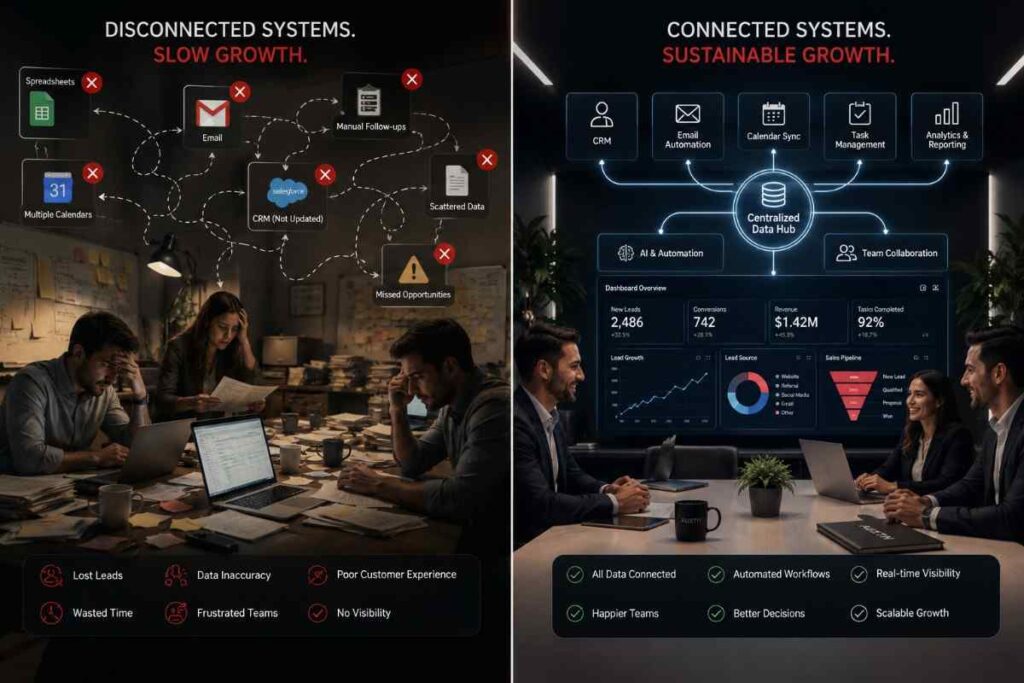
Disconnected systems don’t just create inconvenience, they directly impact profitability. Employees lose valuable time switching between platforms, customers experience slower response times, and leadership lacks accurate data for decision-making.
Research consistently shows that employees spend a significant portion of their workday searching for information, switching applications, or completing repetitive administrative tasks. While each individual delay may seem minor, these inefficiencies compound across an entire organisation.
For customers, the experience is equally frustrating. Repeating information multiple times, waiting days for responses, or receiving inconsistent communication damages trust and increases the likelihood of choosing a competitor.
Businesses that invest in connected systems often experience improvements in operational visibility, response times, customer satisfaction, and overall productivity because information flows seamlessly between departments instead of remaining isolated.
How Modern Businesses Scale Without Operational Chaos
High-growth businesses rarely succeed because they simply work harder. They succeed because they build systems capable of supporting continued expansion.
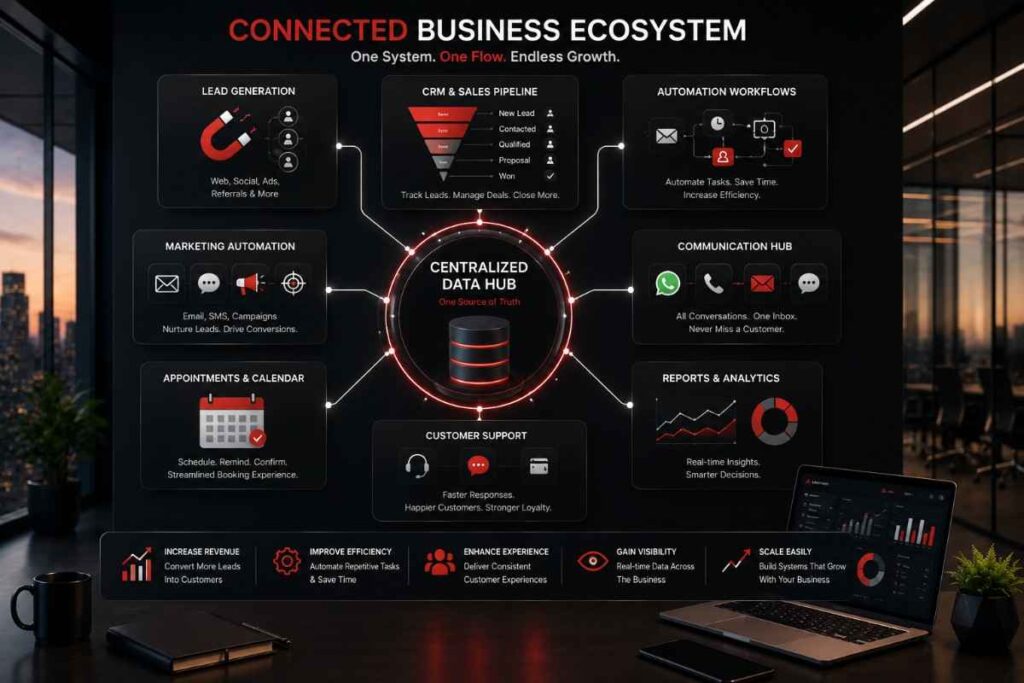
Modern organisations integrate their website, CRM, communication channels, appointment scheduling, reporting, marketing, and customer support into a connected ecosystem. Instead of employees manually transferring information between platforms, automation handles repetitive tasks while teams focus on higher-value activities.
This doesn’t eliminate the need for people. Instead, it enables employees to spend more time solving customer problems, building relationships, and making strategic decisions rather than managing administrative work.
Technology should support people, not replace them.
Practical Steps to Break Through Your Systems Ceiling
Breaking through a systems ceiling doesn’t require replacing every piece of software overnight. Instead, businesses should begin by evaluating where operational friction occurs most frequently.
Start by mapping your customer journey from the initial enquiry through ongoing service delivery. Identify every manual step, duplicated process, and communication delay. These areas often represent the greatest opportunities for improvement.
Next, prioritise system integration over adding new tools. Businesses frequently purchase additional software to solve isolated problems, only to create even greater fragmentation. A smaller number of well-connected systems generally produces better outcomes than dozens of disconnected applications.
Finally, measure operational success using metrics beyond revenue alone. Response times, customer satisfaction, automation rates, employee productivity, and reporting accuracy provide valuable insights into how effectively your systems support growth.
Conclusion
Every growing business eventually reaches a point where operational complexity begins to outpace existing systems. While many organisations respond by hiring additional staff or purchasing more software, sustainable growth depends on building connected processes that eliminate friction rather than adding more layers of complexity.
A systems ceiling isn’t a sign that your business has stopped growing, it’s an indication that your operations need to evolve. By identifying bottlenecks, integrating essential business systems, and automating repetitive tasks, companies can create a foundation that supports long-term growth without sacrificing efficiency or customer experience.
The businesses that scale successfully aren’t necessarily the ones with the largest teams or the biggest budgets. They’re the ones with systems designed to grow alongside them.
Key Takeaways
- Growth often exposes weaknesses in business operations rather than creating them.
- Manual processes eventually become barriers to scalability.
- Disconnected systems increase costs, delays, and operational errors.
- Integrated business systems improve efficiency, visibility, and customer experience.
- Sustainable growth depends on scalable processes, not just additional resources.

Frequently Asked Questions
What is a systems ceiling in business?
A systems ceiling is the point at which a company’s existing processes and technology can no longer support continued growth efficiently, leading to bottlenecks, delays, and reduced productivity.
How do I know if my business has reached a systems ceiling?
Common signs include increasing manual work, disconnected software, slower customer response times, duplicated tasks, and declining operational efficiency despite business growth.
Can automation solve a systems ceiling?
Automation can significantly reduce repetitive tasks and improve workflow efficiency, but it delivers the best results when combined with well-integrated business systems and clearly defined processes.
Why are connected business systems important?
Connected systems allow information to flow seamlessly between departments, reducing manual work, improving collaboration, enhancing customer experiences, and providing leaders with accurate, real-time insights.
Grow Your Business
If your business is growing but your operations feel increasingly difficult to manage, it may be time to evaluate the systems supporting your growth. Building connected processes today can help you scale more efficiently, improve customer experiences, and create a stronger foundation for long-term success.
Related Articles
What Is GoHighLevel? The Complete Business Guide (2026)
Learn what GoHighLevel is, how it works, its key features, benefits, pricing, and why businesses use it to automate marketing, sales, and customer management.
10 GoHighLevel Features Every Growing Business Should Use in 2026
Discover the 10 most powerful GoHighLevel features that help businesses automate marketing, manage leads, build sales funnels, streamline customer communication, and improve efficiency, all from one all-in-one business platform.
What Is Business Automation? A Complete Beginner's Guide
Discover how business automation helps companies streamline repetitive tasks, improve productivity, reduce errors, and create more efficient workflows.