
Why Process Documentation Is the Foundation of Every Scalable Business

Why Businesses Stop Growing
Every entrepreneur dreams of building a business that grows beyond their personal involvement. Increased revenue, a larger customer base, expanding teams, and new market opportunities are all signs of progress. Yet many businesses discover that growth brings an unexpected challenge: the business becomes increasingly difficult to manage.
Simple tasks that once took minutes now require multiple approvals. Employees begin asking the same questions repeatedly, new hires struggle to understand established workflows, and customers experience inconsistent service depending on who handles their request. Leadership spends more time solving internal operational problems than focusing on strategic growth.
This situation is often mistaken for a staffing issue or a technology problem. Companies respond by hiring additional employees or purchasing new software, expecting these investments to restore efficiency. While these actions may provide temporary relief, they rarely solve the underlying issue.
In many cases, the real problem is much simpler. The business operates almost entirely on knowledge stored inside people's heads rather than within documented systems.
When employees leave, valuable knowledge leaves with them. When managers are unavailable, decisions slow down. When new team members join, training becomes inconsistent because everyone explains processes differently.
This is where business process documentation becomes essential. Rather than relying on individuals to remember how work should be completed, successful businesses create documented systems that allow every employee to perform consistently regardless of who is involved.
Businesses don't become scalable because they hire more people. They become scalable because they build repeatable processes that every person can follow.
What Is Business Process Documentation?
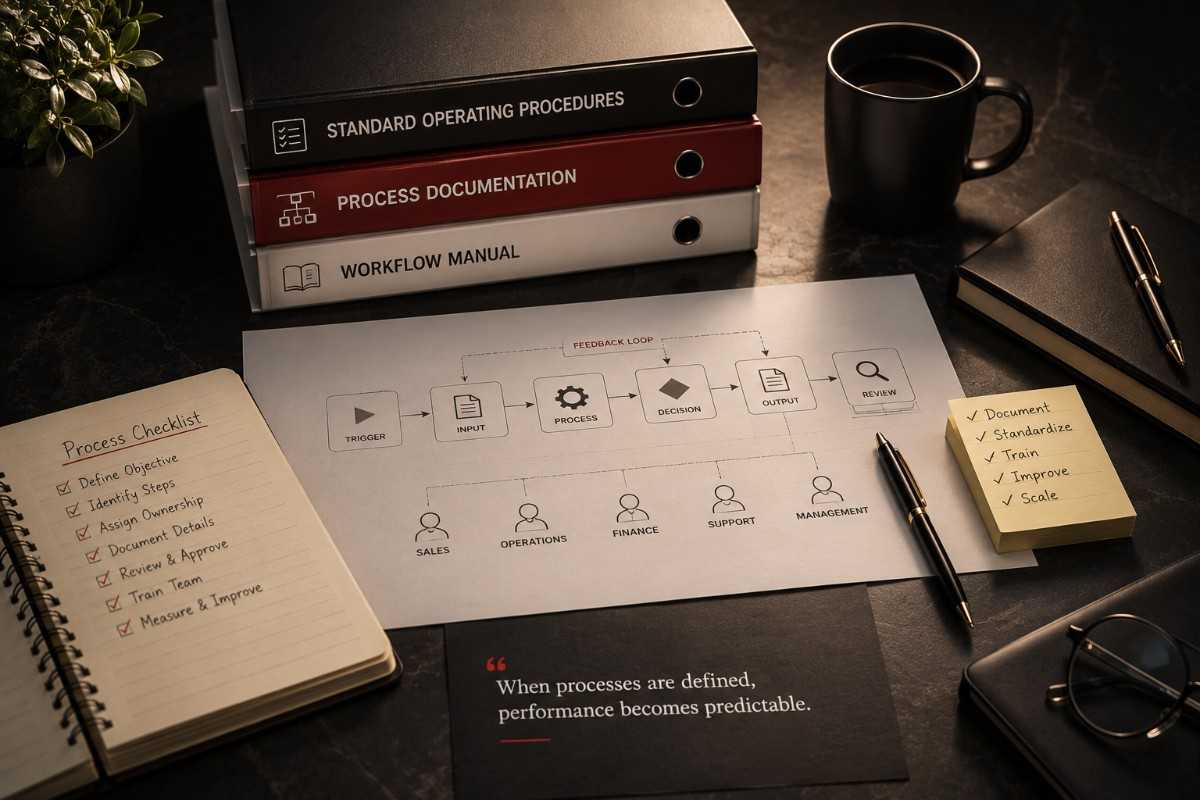
Business Process Documentation is the practice of recording how work is performed within an organisation. It transforms everyday knowledge into structured documentation that employees can easily understand, follow, and improve over time.
Process documentation can take many forms, including written procedures, Standard Operating Procedures (SOPs), workflow diagrams, decision trees, training manuals, checklists, and process maps. Regardless of the format, the objective remains the same: ensuring every critical business activity follows a consistent and repeatable method.
Consider the process of onboarding a new customer. Without documentation, one employee may collect customer information through email, another might use a spreadsheet, while someone else records everything directly into the CRM. Although each employee completes the task, the customer experience becomes inconsistent and important information may be overlooked.
With a documented process, every team member follows the same sequence of steps. Customer information is collected using the same forms, entered into the same system, verified using the same checklist, and communicated through the same channels. The outcome becomes predictable, measurable, and significantly easier to improve.
Documentation also provides leadership with visibility into how work actually flows throughout the organisation. Instead of relying on assumptions, managers can identify unnecessary steps, duplicated effort, and opportunities for improvement.
Ultimately, documented processes create consistency, and consistency is one of the defining characteristics of scalable businesses.
Why Growing Businesses Depend Too Much on People
During the early stages of a business, relying on individual knowledge often feels natural. Founders personally oversee operations, employees communicate informally, and decisions happen quickly because everyone understands the business intimately.
As organisations expand, however, this approach becomes increasingly risky. New employees cannot learn years of organisational knowledge through observation alone. Managers become overwhelmed answering repetitive questions, while experienced employees become indispensable because they are the only people who understand certain workflows.
This phenomenon is commonly known as tribal knowledge — critical information that exists only in the minds of specific individuals rather than within documented systems.
Although tribal knowledge may appear efficient initially, it creates significant operational risks. If a key employee resigns unexpectedly, projects may stall while remaining staff attempt to reconstruct undocumented procedures. Customer service quality may decline because replacements unknowingly follow different methods. Even routine tasks become difficult when nobody knows the "correct" way to complete them.
Founder dependency creates an even greater challenge. Many businesses unintentionally require the owner to approve every decision, answer every operational question, or resolve every customer issue. While this level of involvement may have been practical during the company's early years, it quickly becomes a bottleneck as the organisation grows.
Scalable businesses reduce dependency on individuals by building dependable systems instead. Knowledge becomes organisational property rather than personal expertise.

The Benefits of Documented Processes
Process documentation is often viewed as administrative work, but its impact extends far beyond creating manuals or checklists. Well-documented processes improve nearly every aspect of business operations.
One of the most significant advantages is consistency. Customers receive the same high-quality experience regardless of which employee serves them. Consistent service strengthens trust, improves brand reputation, and reduces costly mistakes.
Documentation also accelerates employee onboarding. Instead of relying solely on shadowing experienced colleagues, new hires gain access to structured resources that explain responsibilities, expectations, and workflows. This shortens training time while increasing employee confidence.
Operational efficiency improves because employees spend less time searching for information or asking repetitive questions. Managers regain valuable time that would otherwise be spent explaining routine procedures.
Documented processes also provide an excellent foundation for continuous improvement. Once workflows are clearly defined, organisations can evaluate performance, identify bottlenecks, and refine procedures based on measurable outcomes rather than assumptions.
Perhaps most importantly, documentation prepares businesses for automation. Before repetitive tasks can be automated, organisations must first understand exactly how those tasks are performed. Businesses that document their processes thoroughly are far better positioned to implement automation successfully because their workflows are already structured and standardised.
| Without Process Documentation | With Process Documentation |
|---|---|
| Knowledge stays with individuals. | Knowledge belongs to the organisation. |
| Inconsistent customer experiences. | Consistent service delivery. |
| Slow employee onboarding. | Structured and faster training. |
| Founder becomes operational bottleneck. | Teams operate independently. |
| Automation is difficult to implement. | Processes are ready for automation. |
How to Document Business Processes Effectively
Many businesses recognise the importance of documentation but delay creating it because they believe the process is too time-consuming or complicated. In reality, effective process documentation doesn't require lengthy manuals or dozens of pages. It requires clarity, consistency, and a structured approach.
The first step is identifying the processes that have the greatest impact on daily operations. These typically include customer onboarding, sales handovers, proposal creation, invoicing, project delivery, customer support, and employee onboarding. Rather than documenting every activity at once, begin with the workflows that are repeated most frequently or where mistakes occur most often.
Once a process has been identified, map it from start to finish. Ask questions such as:
- What triggers the process?
- Who is responsible for each step?
- What tools or systems are involved?
- What information is required?
- What is the expected outcome?
This exercise often reveals unnecessary approvals, duplicated work, or manual tasks that can be simplified. Many businesses discover inefficiencies simply by visualising their workflows for the first time.
The documentation itself should be written in clear, practical language. Avoid jargon and assumptions that only experienced employees would understand. Every process should explain not only what needs to be done but also why it matters.
Visual elements can also improve usability. Flowcharts, screenshots, checklists, and short instructional videos make documentation easier to understand than lengthy text alone.
Finally, process documentation should never be treated as a one-time project. Businesses evolve, technology changes, and customer expectations shift. Documentation should be reviewed regularly to ensure it continues reflecting how work is actually performed rather than how it was performed years ago.

Common Mistakes Businesses Make When Documenting Processes
Simply creating documentation does not guarantee operational improvement. Many organisations invest considerable effort into documenting processes only to discover that employees ignore them or that the documentation quickly becomes outdated.
One of the most common mistakes is documenting processes that already contain unnecessary complexity. If a workflow requires twelve approval steps when only six are necessary, documenting it simply preserves inefficiency. Businesses should simplify processes before formalising them.
Another frequent mistake is creating documentation that is too detailed. While thoroughness is valuable, employees rarely have time to read lengthy manuals during their daily work. Breaking procedures into clear steps with supporting visuals often produces far better results than writing extensive paragraphs of instructions.
Businesses also fail when documentation is created by management without involving the employees who perform the work every day. Frontline staff often identify practical improvements that leadership may overlook.
Perhaps the biggest mistake is allowing documentation to become outdated. Assigning ownership for reviewing and updating documentation ensures it remains relevant as the business grows.
Process Documentation Is the First Step Toward Digital Transformation
One of the biggest misconceptions about digital transformation is that it begins with technology. In reality, successful digital transformation begins with understanding how work is currently performed.
Many organisations purchase CRM platforms, automation software, project management tools, or AI solutions before defining the processes those technologies are expected to support. As a result, businesses simply digitise inefficient workflows rather than improving them.
Imagine automating a customer onboarding process that differs between every employee. Instead of creating consistency, automation amplifies inconsistency. The technology performs exactly what it has been instructed to do — even if the underlying process is flawed.
This is why process documentation serves as the bridge between business operations and digital transformation. Once workflows have been standardised, organisations can identify repetitive tasks, remove unnecessary steps, and implement technology where it delivers the greatest value.
Documentation creates the blueprint. Automation simply brings that blueprint to life.
- Business growth becomes difficult when knowledge exists only within individual employees.
- Process documentation creates consistency, improves accountability, and reduces operational risk.
- Standard Operating Procedures (SOPs) accelerate onboarding and improve service quality.
- Documenting workflows helps identify inefficiencies before investing in new technology.
- Well-documented processes provide the foundation for successful automation and digital transformation.
- Scalable businesses build systems that can operate consistently regardless of who performs the work.
Frequently Asked Questions
Business process documentation is the practice of recording how tasks and workflows are completed within an organisation. It typically includes Standard Operating Procedures (SOPs), workflow diagrams, checklists, and process maps that help teams perform work consistently and efficiently.
As businesses grow, relying on verbal instructions and individual experience becomes increasingly risky. Documented processes reduce operational inconsistencies, improve employee onboarding, minimise errors, and create repeatable systems that support sustainable growth.
An effective SOP should clearly define the purpose of the process, the people responsible, the required tools, each step of the workflow, expected outcomes, and any quality or compliance requirements. It should also be reviewed regularly to ensure it remains accurate as the business evolves.
Yes. Automation works best when it supports well-defined and consistent workflows. Documenting processes first helps identify inefficiencies, eliminate unnecessary steps, and ensure automation improves operations instead of reinforcing existing problems.
Conclusion
Every successful business eventually reaches a point where growth depends less on individual effort and more on operational consistency. While talented employees and capable leaders remain essential, sustainable growth is built on systems that can be repeated, measured, and continuously improved.
Business process documentation transforms scattered knowledge into organisational knowledge. It enables teams to work with greater confidence, accelerates employee onboarding, improves customer experiences, and reduces the risks associated with staff turnover or founder dependency.
Companies that invest time in documenting their processes today are not simply creating manuals — they are building the operational foundation that supports future growth.
Ready to build a stronger operational foundation?
At AUXTH, we help businesses analyse, optimise, and document their workflows before implementing automation and digital transformation solutions.
Book a Strategy Call