
How to Build a Reputation Management System That Creates Long-Term Trust
- Reading Time : 10 min
- Category : Reputation
- Updated Date : 24-08-2026

Table Of Content
- Reputation Starts With the Customer Experience
- Reputation Management Should Be a Process, Not a Task
- The Customer Feedback Loop
- How Reviews Influence the Customer Journey
- Make Asking for Reviews Part of the Processl
- The Difference Between Collecting Reviews and Building Reputation
- Your Reputation Is Built One Customer at a Time
- Final Thoughts
Introduction
A business can spend thousands on advertising, invest heavily in its website and generate hundreds of enquiries, but there is one factor that can influence almost every stage of the customer journey: reputation. Before contacting a business, potential customers often look for evidence that they can trust it. They search for reviews, read customer experiences, look at testimonials and assess how the company responds to feedback. In many cases, this happens before a salesperson ever gets the opportunity to speak with them.
This means reputation is no longer something businesses can simply leave to chance. It needs to be managed as part of the wider customer experience. The challenge is that many businesses still approach reputation reactively. They notice reviews when someone leaves one, respond to negative feedback when it becomes a problem and occasionally ask customers for testimonials when they need them for marketing.
A stronger approach is to build a reputation management system that works continuously. Instead of treating reputation as an occasional marketing task, businesses can create a structured process that connects customer experience, feedback, reviews, follow-up and ongoing improvement.
Reputation Starts With the Customer Experience
No reputation strategy can compensate for consistently poor customer experiences. The foundation has to be the experience itself. When customers receive reliable service, clear communication and a professional experience, the business creates the conditions for positive feedback. When those experiences are inconsistent, no amount of review requests will solve the underlying problem.
This is why reputation management should begin long before a review is requested. Businesses should look at the entire customer journey and identify where customers form opinions about the company. This could include the first enquiry, communication with the team, the sales process, delivery of the service, after-sales support and ongoing communication. Every one of these interactions contributes to the reputation customers eventually share with others.
Reputation Management Should Be a Process, Not a Task
The difference between a business that occasionally collects reviews and one that has a reputation management system comes down to consistency. A task depends on someone remembering to do it. A system defines what should happen, when it should happen and what happens next. For example, after a successful customer interaction, the business may have a defined process for requesting feedback. Positive feedback can then become an opportunity to generate a public review or testimonial, while constructive feedback can provide an opportunity for the business to identify an issue and improve the customer experience.
The process creates consistency without requiring the team to remember every individual opportunity. This is particularly important as a business grows. A manual reputation process that works for twenty customers may become difficult to maintain when the business is serving hundreds or thousands.

The Customer Feedback Loop
One of the most valuable parts of a reputation management system is the feedback loop. The idea is simple. Customers experience your business, provide feedback, the business learns from that feedback and improvements are made to the customer experience. Better experiences can then lead to stronger reviews and greater trust.
This creates a cycle rather than a one-time activity. The goal isn’t simply to collect positive comments. Feedback can reveal weaknesses that the business may not otherwise see. If several customers mention slow communication, that is useful information. If customers repeatedly praise a particular part of the service, that is useful information too. Both positive and negative feedback can help the business understand what customers actually value.
The Structure of a Reputation Management System
| System Stage | What Happens | Purpose |
|---|---|---|
| Customer Experience | Customer interacts with the business | Create a positive experience worth sharing |
| Feedback Request | Customer is invited to share their experience | Generate genuine customer feedback |
| Review Generation | Satisfied customers can share public feedback | Build visible social proof |
| Response | Business acknowledges and responds to feedback | Demonstrate responsiveness and professionalism |
| Analysis | Feedback is reviewed for recurring themes | Identify strengths and weaknesses |
| Improvement | Business improves processes and customer experience | Strengthen future customer outcomes |
Reputation Management Can Be Connected to Automation
As businesses grow, managing every review request manually can become inefficient. This is where automation can support the process. A connected system can identify relevant customer events and trigger appropriate communication. For example, when a service is completed, a customer may enter a feedback workflow. A follow-up message can be sent at an appropriate time, followed by another reminder if necessary.
The exact process should depend on the business and its customer journey. Automation should not make communication feel robotic. Its purpose should be to ensure that important opportunities are not forgotten. The human element remains essential.

Turn Positive Experiences Into More Than Reviews
A strong customer experience can produce much more than a star rating. A detailed review might become a testimonial on your website. A successful customer story could become a case study. A particularly strong customer comment could become social media content. A recurring customer success pattern could help strengthen your sales messaging.
This means reputation can feed other areas of marketing. Instead of creating every marketing message internally, businesses can use genuine customer experiences to demonstrate their value. The customer becomes part of the story. That often makes the marketing more credible.
Reputation Should Be Measured Over Time
A reputation management system should also provide visibility into what is changing. Businesses can monitor metrics such as:
- Review volume over time
- Average rating
- Review recency
- Response activity
- Common customer feedback themes
- Customer satisfaction trends
- Sources generating the most reviews
- Changes in reputation following operational improvements
The purpose isn’t to obsess over a single number. The purpose is to understand whether customer experience and public perception are moving in the right direction. A business with a strong reputation today should still be paying attention six months from now. Reputation is an ongoing asset.
Final Thoughts
Your online reputation is the visible result of countless customer experiences. That means protecting and strengthening it requires more than asking customers for reviews. It requires a system. A system that begins with customer experience, creates opportunities for genuine feedback, responds professionally, identifies recurring issues and uses customer insights to improve the business.
When those elements work together, reputation becomes more than social proof. It becomes a growth asset. Future customers see evidence that your business can be trusted. Your marketing gains credibility. Your sales conversations begin with greater confidence. Your team gains valuable insight into the customer experience. And the business develops something that cannot be created through advertising alone. Trust.
Frequently Asked Questions
What is a reputation management system?
A reputation management system is a structured process for monitoring customer feedback, generating genuine reviews, responding to feedback and using customer insights to improve the overall customer experience.
Why does a business need a reputation management system?
A structured system makes reputation management consistent. Instead of relying on employees to remember when to request reviews or respond to feedback, the business has a defined process that operates alongside the customer journey.
How can automation help with reputation management?
Automation can help businesses identify appropriate moments to request customer feedback and send follow-up communication. It can reduce manual work while making the process more consistent.
Should businesses ask every customer for a review?
Businesses should create a genuine and appropriate feedback process based on their customer journey. Review requests should not manipulate or fabricate feedback. The objective is to make it easy for customers to share authentic experiences.
What should a business do with negative feedback?
Negative feedback should be reviewed professionally to understand what happened. Businesses should respond appropriately and look for recurring issues that could indicate opportunities to improve the customer experience.
Build a Reputation System That Works Continuously
Your reputation shouldn’t depend on someone remembering to ask for a review or responding to feedback only when a problem appears. Auxth helps businesses connect customer experience, reputation management, CRM and automation into structured digital growth systems.
If your business wants to turn customer experiences into stronger trust, better social proof and long-term growth, book a Strategy Session with Auxth and discover how a connected reputation system can work for your business.
Related Articles
What Is GoHighLevel? The Complete Business Guide (2026)
Learn what GoHighLevel is, how it works, its key features, benefits, pricing, and why businesses use it to automate marketing, sales, and customer management.
10 GoHighLevel Features Every Growing Business Should Use in 2026
Discover the 10 most powerful GoHighLevel features that help businesses automate marketing, manage leads, build sales funnels, streamline customer communication, and improve efficiency, all from one all-in-one business platform.
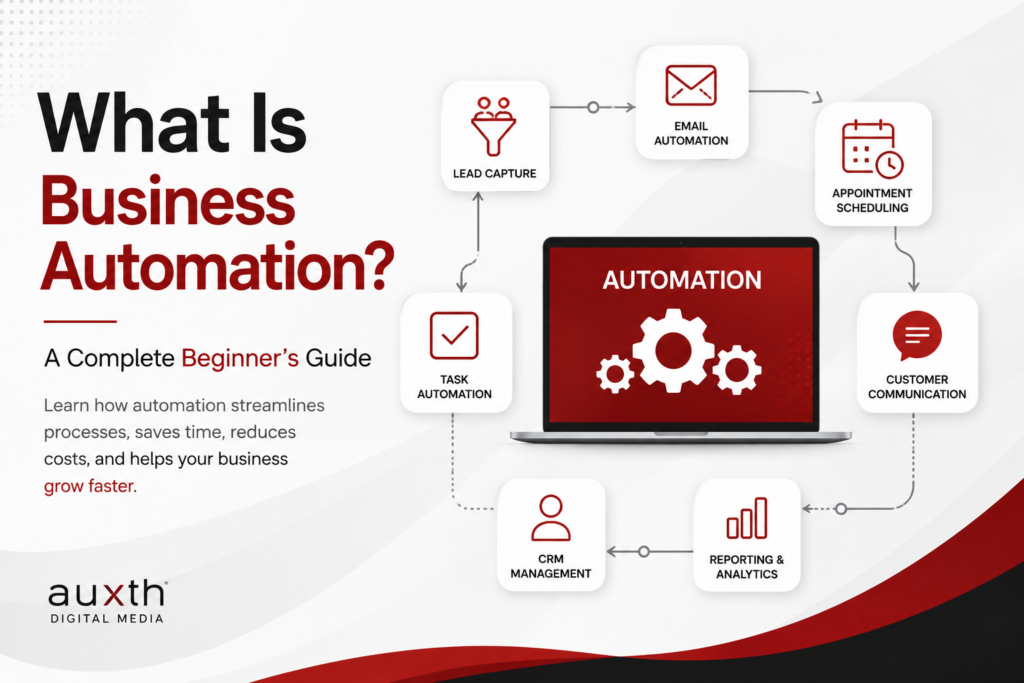
What Is Business Automation? A Complete Beginner's Guide
Discover how business automation helps companies streamline repetitive tasks, improve productivity, reduce errors, and create more efficient workflows.