
B2B Lead Generation: How to Build a System That Creates Qualified Conversations
- Reading Time : 10 min
- Category : Outbound System
- Updated Date : 10-08-2026
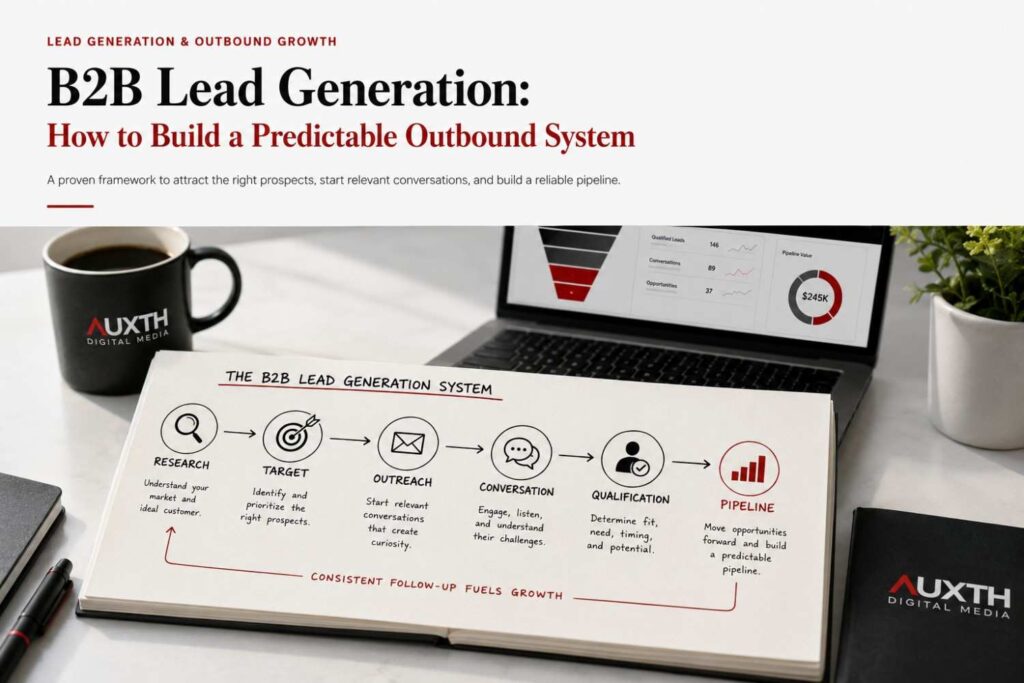
Table Of Content
- What Is B2B Lead Generation?
- Why More Leads Do Not Always Mean More Revenu
- The 6 Components of a Predictable B2B Lead Generation System
- The Real Journey From Prospect to Revenue
- Why Outbound Lead Generation Fails
- Outbound Is Not a Race to Send More Messages
- The Role of Automation in B2B Lead Generation
- How to Measure B2B Lead Generation
- What a Predictable Lead Generation System Looks Like
- A Practical B2B Lead Generation Framework
- The Future of B2B Lead Generation
- Final Takeaway
Introduction
Most businesses do not have a lead shortage. They have a consistency problem.
They may have a database of prospects, a CRM, salespeople, marketing campaigns and several tools for outreach. Yet their pipeline still rises and falls unpredictably. One month produces strong conversations and promising opportunities, while the next month feels noticeably quieter. When this happens, the natural response is usually to increase activity. The team sends more emails, adds more prospects, increases outreach volume or starts looking for another lead generation platform. But increasing activity does not necessarily solve the underlying problem.
Predictable B2B lead generation is not about producing the largest possible number of contacts. It is about creating a repeatable process that consistently identifies the right prospects, starts relevant conversations, nurtures those relationships and turns qualified interest into pipeline. That distinction changes how an entire business approaches outbound growth.
What Is B2B Lead Generation?
B2B lead generation is the process of identifying potential business customers and creating opportunities for those prospects to begin a commercial conversation with your company.
The process can involve market research, ideal customer profiling, prospect identification, data enrichment, outbound outreach, content, follow up, qualification and CRM management. These activities are often treated as separate functions, but the strongest lead generation systems connect them.
A prospect should not simply enter a database and disappear. There should be a clear progression from identifying the right company to understanding its situation, starting a relevant conversation, determining whether there is a genuine opportunity and moving that opportunity into the pipeline.
The objective is therefore not simply to create more leads. The objective is to create more of the right conversations with the right businesses at the right time.
Why More Leads Do Not Always Mean More Revenu
Lead volume is easy to measure, which is why businesses often become obsessed with it.
A company generates 5,000 new contacts this month and considers the campaign successful. Another company generates 500 carefully researched prospects and appears to have produced less.
But what happens when those 5,000 contacts are poorly targeted? What happens when the prospects have no genuine need for the service? What happens when the outreach is generic, follow up is inconsistent and interested prospects are not tracked? The larger database can actually create more noise than opportunity.
The second company may have fewer prospects but generate significantly more meaningful conversations and qualified opportunities. This is why a strong B2B lead generation strategy must optimise for relevance and commercial potential rather than raw volume.
The 6 Components of a Predictable B2B Lead Generation System
A reliable outbound system is built from several connected stages. Each stage has a specific purpose, and the quality of one stage affects the performance of the next.
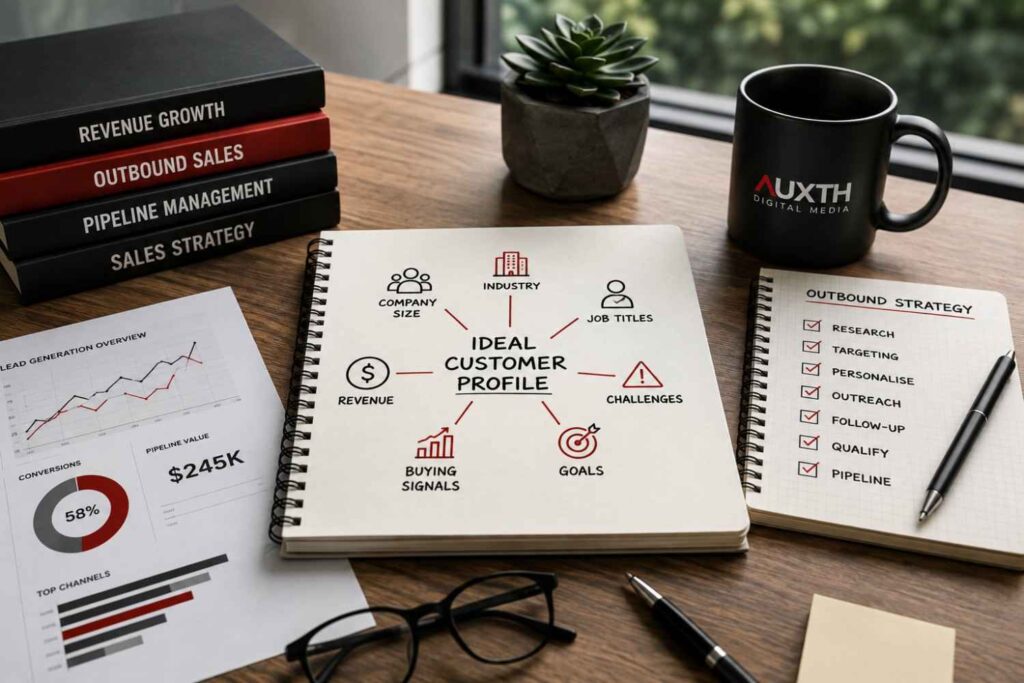
1. Define Your Ideal Customer Profile
Before searching for prospects, you need to know exactly who should be approached.
An ideal customer profile should define characteristics such as industry, company size, geography, business model, decision maker, common challenges and buying signals. It should also identify the characteristics that make a prospect a poor fit.
This sounds basic, but many outbound campaigns skip this step. They begin with a large database and ask the sales team to contact as many people as possible. That reverses the process.
A strong lead generation system begins with the customer rather than the contact list. When the ideal customer profile is clear, prospecting becomes more focused, messaging becomes more relevant and sales teams spend less time talking to businesses that were unlikely to buy in the first place.
2. Research the Prospect Before Contacting Them
The quality of an outbound conversation is often determined before the first message is written.
Research gives you context. Context gives you a reason to contact someone. A company that recently expanded into a new market may have different priorities from a company that has remained in the same market for ten years. A business that is rapidly hiring may have different challenges from one that has just reduced its workforce. A company launching a new service may be more receptive to certain conversations than one operating under completely different priorities.
These signals matter because they allow outreach to become specific. Instead of saying, “We help businesses improve their sales,” you can identify something relevant about the prospect’s current situation and build the conversation around it. That does not mean writing an essay for every prospect. It means understanding enough about the person and their business to make the outreach feel intentional.
3. Create Relevant Outreach
Most decision makers receive sales messages every day. Many of those messages look almost identical.
“We help companies like yours.”
“I wanted to introduce myself.”
“We specialise in helping businesses grow.”
“Would you be available for a quick call?”
The problem is not necessarily that these messages are badly written. The problem is that they give the recipient very little reason to care. Effective outbound starts with relevance. The prospect should be able to understand why the conversation may be useful to them rather than simply why the sender wants their attention.
This is where research becomes important. When an outreach message is based on something specific about the prospect’s business, the interaction feels different. It demonstrates that some thought went into the contact instead of making the recipient feel like another name on a list. The objective of the first message should not always be to close a meeting immediately. Sometimes the better objective is simply to create enough relevance and curiosity for a genuine business conversation to begin.
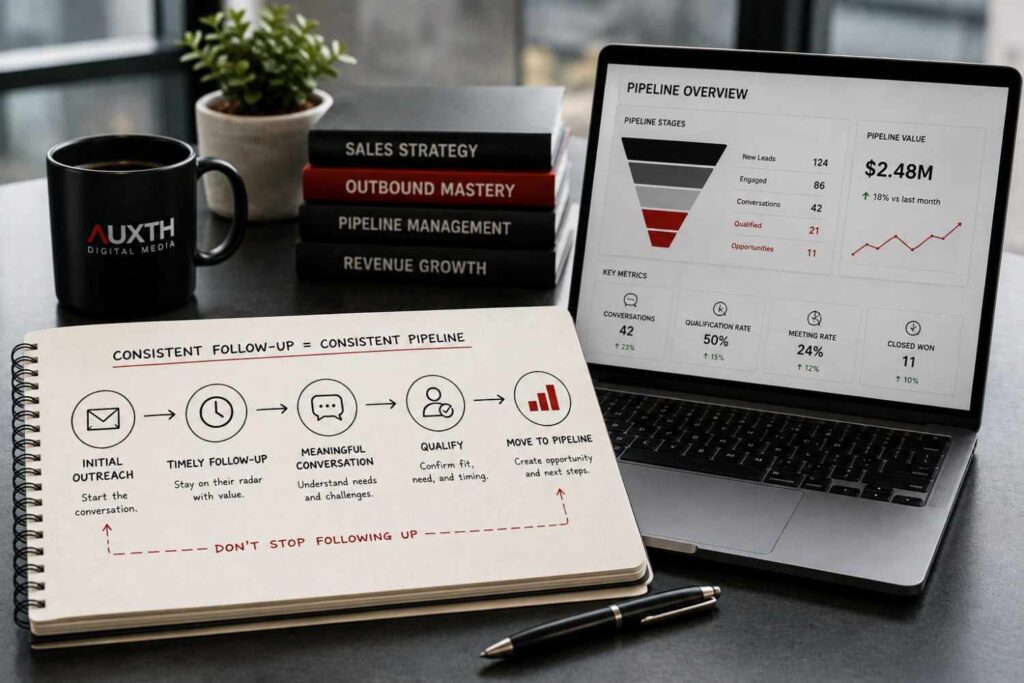
4. Build Follow Up Into the Process
A prospect who does not respond today is not necessarily a prospect who will never respond.
They may be busy. They may have missed the message. The timing may not be right. They may have seen the message and decided to revisit it later.
This is why follow up is fundamental to B2B lead generation.
However, effective follow up is not about sending the same message repeatedly. “Just following up” provides very little additional value. A stronger approach gives the prospect another reason to engage. That could be a relevant insight, an observation about their market, a useful resource, a response to something they have published or a different perspective on the original topic.
Good follow up keeps the conversation alive without creating unnecessary pressure. More importantly, it should be systematic. If follow up depends entirely on someone’s memory, opportunities will eventually disappear.
5. Qualify Conversations Before Calling Them Opportunities
Not every response is a qualified lead. Someone might respond out of curiosity. Someone else might be interested but have no relevant need. Another prospect may be a strong fit but have no authority to make the decision.
A lead generation system needs a consistent qualification process. Depending on the business, this may involve understanding the prospect’s current situation, business need, authority, timing, budget, existing solution and potential fit.
The purpose is not to interrogate prospects. It is to determine whether the conversation has genuine commercial potential. This distinction becomes particularly important as outbound volume grows. Without qualification, sales teams can spend significant amounts of time pursuing conversations that were never likely to become opportunities.
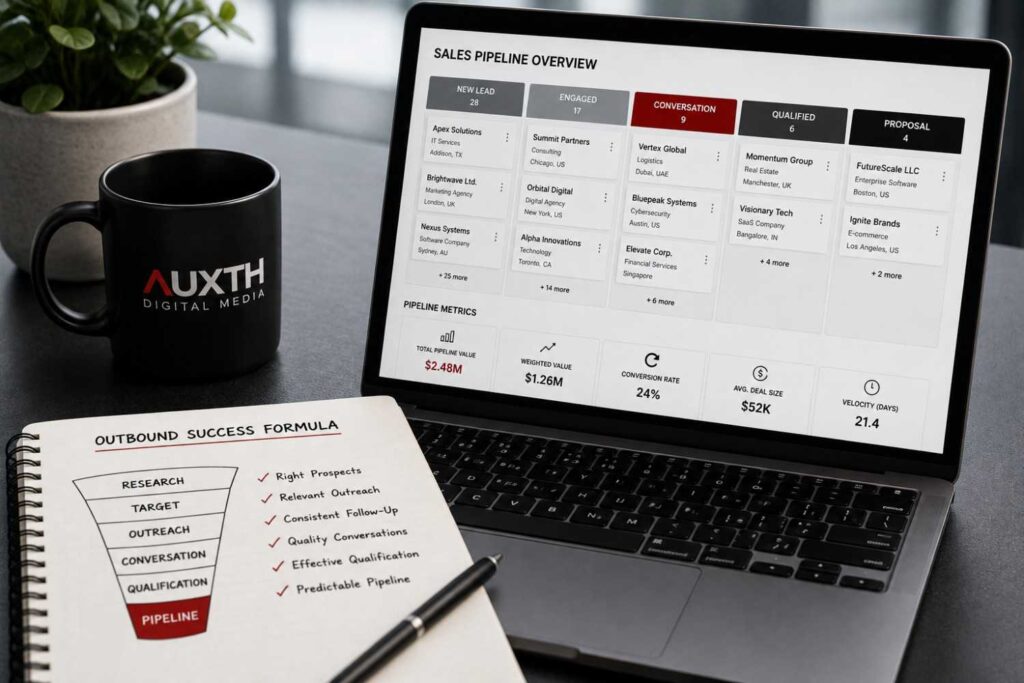
6. Track Everything Through the Pipeline
A conversation should never disappear simply because it started in an inbox. Once someone responds, the business should know where that relationship stands.
Is the prospect newly engaged? Are they qualified? Is there a meeting scheduled? Are they considering a proposal? Are they not ready yet? When should the next follow up happen?
This is where the CRM becomes important. The CRM does not create the pipeline. The business development process creates the pipeline. The CRM provides the visibility needed to manage that process consistently. When every meaningful conversation has a clear stage, owner and next action, opportunities become much easier to manage.
The Real Journey From Prospect to Revenue
A useful way to think about B2B lead generation is as a progression rather than a single event.
A person starts as an unknown prospect. Research identifies whether they are relevant. Outreach creates an opportunity for interaction. A response creates a conversation. Qualification determines whether that conversation represents a genuine business opportunity. The opportunity then enters the pipeline and can eventually become revenue.
The stages may look simple, but the connections between them are what create predictability.
Prospect → Engagement → Conversation → Qualification → Opportunity → Pipeline → Revenue
If one stage is weak, the stages after it become harder.
Poor targeting creates poor conversations. Poor conversations create weak opportunities. Weak qualification creates an inefficient pipeline. Poor follow up causes otherwise good opportunities to disappear. This is why lead generation should be designed as a system rather than treated as a collection of disconnected activities.
Why Outbound Lead Generation Fails
When outbound campaigns fail, businesses often change the wrong variable. They rewrite the email. They change the sending platform. They increase the number of messages. They purchase another database. They introduce a new automation tool.
Sometimes those changes help. But many outbound problems begin much earlier. The targeting may be wrong. The prospect research may be weak. The offer may not address a meaningful problem. The messaging may focus too heavily on the seller. Follow up may be inconsistent. The sales team may have no clear process for handling responses.
A better approach is to examine the complete system.
Poor Targeting
If the wrong businesses are being contacted, improving the message will not solve the fundamental problem.
Generic Messaging
If the same message could be sent to thousands of unrelated businesses, it is unlikely to feel particularly relevant to any individual prospect.
Insufficient Research
Without context, outreach becomes difficult to differentiate from the large volume of sales messages already competing for attention.
Inconsistent Follow Up
A prospect can express interest and still disappear if nobody takes responsibility for the next step.
Weak Qualification
If every response is treated as an opportunity, sales teams can spend their time on prospects who are unlikely to become customers.
Poor Pipeline Management
Even strong conversations can become lost opportunities when there is no clear visibility into their status or next action.
Outbound Is Not a Race to Send More Messages
The modern outbound industry has created an obsession with volume.
More contacts.
More messages.
More automation.
More follow ups.
The assumption is that increasing activity will automatically increase opportunities. That relationship does not continue indefinitely. As volume increases without an equivalent improvement in relevance, research often becomes weaker. Messages become more generic. Prospects become less engaged. Response quality declines.
The strongest outbound systems therefore focus on the quality of conversations rather than simply the quantity of messages sent. One well researched conversation can create an opportunity that remains valuable for months. One strong relationship can lead to introductions that open an entirely new network. One thoughtful message can create more commercial value than hundreds of generic messages.
Volume creates opportunities for attention. Relevance earns that attention.
The Role of Automation in B2B Lead Generation
Automation can make a lead generation system more efficient, but it should never be mistaken for the system itself. Automation can help businesses organise prospects, enrich data, route leads, schedule follow ups, update CRM records, manage sequences and report on performance. These capabilities can significantly reduce repetitive work.
However, automation cannot decide whether a prospect is genuinely relevant. It cannot replace strategic positioning. It cannot create trust simply by increasing message volume. If the underlying strategy is poor, automation simply allows the poor process to operate faster.
The most effective systems combine human strategy with technology. Research determines who should be contacted. Data provides context. Messaging creates relevance. Automation maintains consistency. The CRM provides visibility. Human conversations create relationships and determine whether genuine opportunities exist. That combination is far more powerful than simply adding another tool to the stack.
How to Measure B2B Lead Generation
Businesses often measure lead generation using the easiest numbers available.
How many contacts were added?
How many messages were sent?
How many people responded?
These metrics can be useful, but they do not tell the complete story. A stronger measurement framework follows the prospect through the entire journey. It examines whether the right businesses are being targeted, whether those prospects are responding, whether responses become meaningful conversations, whether conversations become qualified opportunities and whether those opportunities ultimately produce revenue.
| Metric | What It Measures | Why It Matters |
|---|---|---|
| Qualified Prospects | Quality of targeting | Shows whether the right businesses are entering the system |
| Response Rate | Initial engagement | Shows whether outreach is earning attention |
| Meaningful Conversations | Conversation quality | Shows whether responses are becoming genuine business discussions |
| Qualification Rate | Commercial relevance | Shows whether conversations are producing viable opportunities |
| Meeting Rate | Conversation progression | Shows whether qualified prospects are moving forward |
| Pipeline Value | Commercial potential | Shows the value being created by business development |
| Conversion Rate | Revenue efficiency | Shows how effectively opportunities become customers |
This changes the conversation inside the business. Instead of asking, “How many leads did we generate this month?” leadership can ask, “How effectively are we turning the right prospects into qualified conversations and pipeline?” That is a much more useful question.
What a Predictable Lead Generation System Looks Like
Predictability does not come from knowing exactly which prospect will become a customer. It comes from having a process that consistently creates enough relevant opportunities to make revenue less dependent on chance.
A predictable system knows who it wants to reach, where those prospects can be found and what signals indicate that they may be a good fit. It has a repeatable approach to research, outreach and follow up. It has clear qualification criteria and a pipeline that gives the team visibility into every active opportunity.
Most importantly, the process continues when business is busy. This is where many companies struggle. When revenue is strong, business development becomes less urgent. Client delivery takes priority. Outreach slows down. Follow ups are delayed. Prospecting moves down the list.
Then, several weeks or months later, the pipeline becomes quieter. The business reacts by increasing outreach again. That cycle creates unnecessary volatility. A stronger business development system protects the activity even when the company is busy because the conversations created today may become the revenue of several months from now.
A Practical B2B Lead Generation Framework
For businesses building an outbound growth system, the process can be simplified into nine stages
.
Define: Establish a clear ideal customer profile and identify who represents a genuine fit.
Research: Study relevant prospects and identify business signals, challenges and potential reasons for engagement.
Prioritise: Focus resources on prospects where there is a credible reason to start a conversation.
Personalise: Use the available context to make outreach relevant rather than generic.
Engage: Start conversations without forcing an immediate transaction.
Follow Up: Maintain valuable conversations consistently and give prospects reasons to continue engaging.
Qualify: Determine whether the prospect has the right combination of fit, need, authority and timing.
Track: Keep every meaningful opportunity visible inside the pipeline.
Optimise: Use performance data to improve targeting, messaging, follow up and conversion over time.
This framework creates a connected system where each stage supports the next.
The Future of B2B Lead Generation
Technology is making it easier than ever to identify prospects, collect information and automate outbound activity. That does not mean lead generation is becoming easier.
In many ways, it is becoming more competitive. When almost every business can access prospect databases and automation tools, the advantage shifts away from simply having the ability to contact more people.
The advantage goes to businesses that understand their market better. They know who matters. They recognise meaningful buying signals. They understand what their prospects are dealing with. They create messages that have context. They follow up without becoming intrusive. They know how to turn conversations into relationships and relationships into pipeline.
The future of B2B outbound is therefore not simply about more automation or higher activity. It is about better systems producing more relevant conversations.
Final Takeaway
B2B lead generation should never be reduced to building a large database or sending a large number of messages. A strong lead generation system connects targeting, research, outreach, follow up, qualification and pipeline management into one repeatable process.
The objective is simple: consistently create meaningful conversations with businesses that have a genuine reason to work with you. When that process is working, business development becomes less dependent on referrals, random inbound enquiries or last minute prospecting. The company has an operating system that continues creating opportunities even while the team is focused on delivering for existing clients.
Predictable revenue does not begin with more leads. It begins with the right prospects entering the right conversations consistently.
Frequently Asked Questions
What is B2B lead generation?
B2B lead generation is the process of identifying potential business customers and creating opportunities for those prospects to enter into a commercial conversation with a company. It can include prospect research, outbound outreach, content, follow up, qualification and pipeline management.
What is the best B2B lead generation strategy?
The strongest strategy depends on the business, market and ideal customer. In most B2B environments, an effective system combines precise targeting, prospect research, relevant outreach, consistent follow up, qualification and clear pipeline management.
How do you generate qualified B2B leads?
Start by defining the ideal customer profile, identify businesses that match it and research their current circumstances. Use that information to create relevant outreach, maintain conversations through structured follow up and qualify prospects based on factors such as fit, need, authority and timing.
Is outbound lead generation still effective?
Yes. Outbound remains effective when it is targeted, relevant and supported by consistent follow up. Generic high volume outreach is increasingly easy for prospects to ignore, which makes research and relevance more important.
What is the difference between a lead and a qualified lead?
A lead is a potential prospect who may have some relevance to the business. A qualified lead has been evaluated against specific criteria that indicate a stronger commercial fit, such as business need, authority, timing and suitability for the company’s offer.
Build a Lead Generation System That Keeps Working
If your business only starts prospecting when the pipeline becomes quiet, you are reacting to the problem rather than building the infrastructure that prevents it. A predictable outbound system gives your business a repeatable way to identify the right prospects, start relevant conversations, nurture relationships and create future opportunities.
Build the system before you need the pipeline.
Related Articles
What Is GoHighLevel? The Complete Business Guide (2026)
Learn what GoHighLevel is, how it works, its key features, benefits, pricing, and why businesses use it to automate marketing, sales, and customer management.
10 GoHighLevel Features Every Growing Business Should Use in 2026
Discover the 10 most powerful GoHighLevel features that help businesses automate marketing, manage leads, build sales funnels, streamline customer communication, and improve efficiency, all from one all-in-one business platform.
What Is Business Automation? A Complete Beginner's Guide
Discover how business automation helps companies streamline repetitive tasks, improve productivity, reduce errors, and create more efficient workflows.