
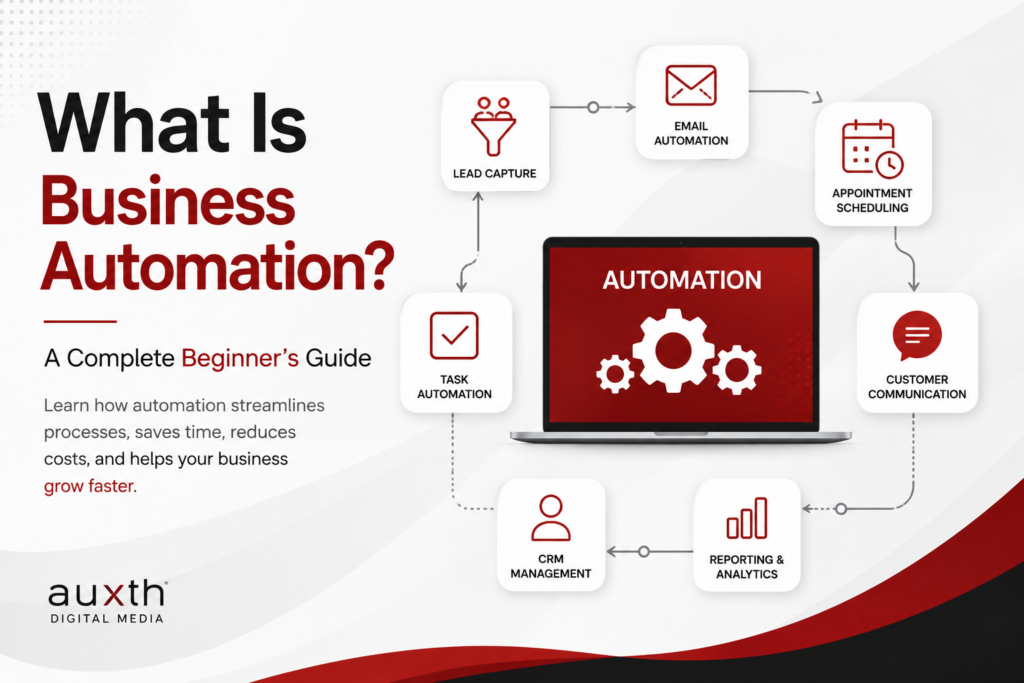
What Is Business Automation? A Complete Beginner's Guide
- Reading Time : 10 min
- Category : Buisness Automations
- Updated Date : 14-07-2026
In This Guide
- • What Is Business Automation?
• Common Examples of Business Automation
• Benefits of Business Automation
• Is Business Automation Right for Your Business?
• How to Get Started with Automation
• Frequently Asked Questions
Introduction
Every growing business eventually reaches a point where manual processes begin slowing progress. Tasks like following up with leads, sending emails, updating spreadsheets, scheduling appointments, and managing customer information consume valuable time that could be spent growing the business.
This is where business automation becomes a game changer.
Rather than replacing people, automation eliminates repetitive tasks so teams can focus on higher-value work like serving customers, closing sales, and developing new opportunities.
What Is Business Automation?
Business automation is the use of software and technology to perform repetitive business processes automatically with little or no human intervention.
Instead of manually completing the same tasks every day, automated workflows handle those processes for you. Whether it’s sending welcome emails, assigning leads to your sales team, updating your CRM, or scheduling social media posts, automation keeps your business running efficiently behind the scenes.
The goal is simple: reduce manual work, improve accuracy, and save time.
Common Examples of Business Automation
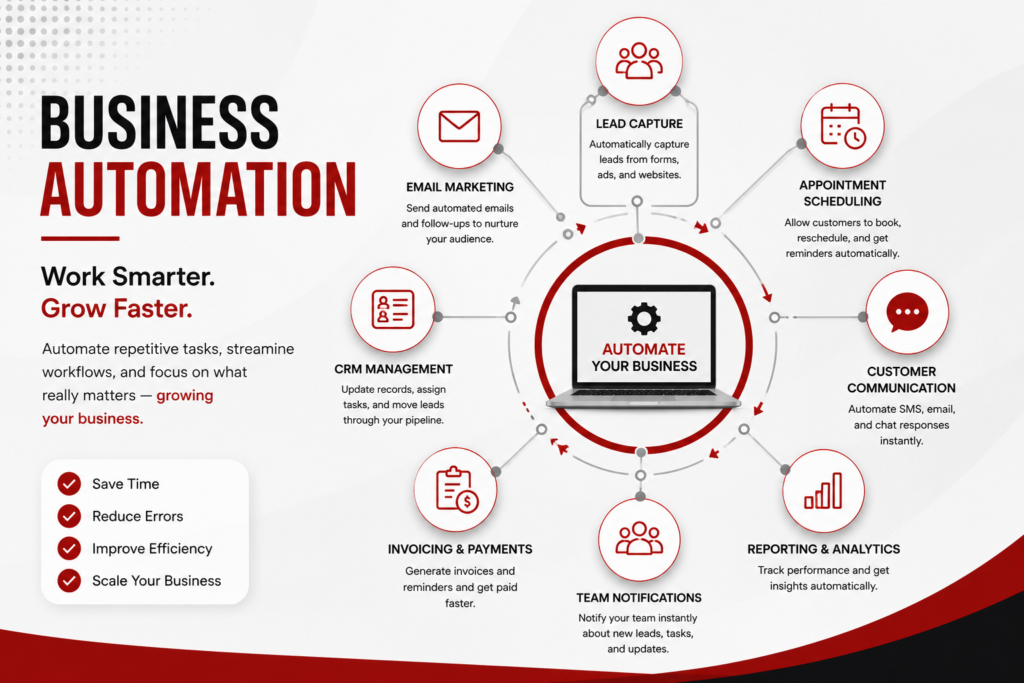
Automation can be applied across almost every department in a business. Some of the most common examples include:
- Automatically responding to new customer enquiries.
- Sending follow-up emails after a form submission.
- Assigning leads to sales representatives.
- Scheduling social media content.
- Creating invoices automatically.
- Sending appointment reminders via email or SMS.
- Collecting customer reviews after a completed service.
- Updating CRM records without manual data entry.
These small automations work together to create a more efficient business operation.
Why Businesses Are Investing in Automation
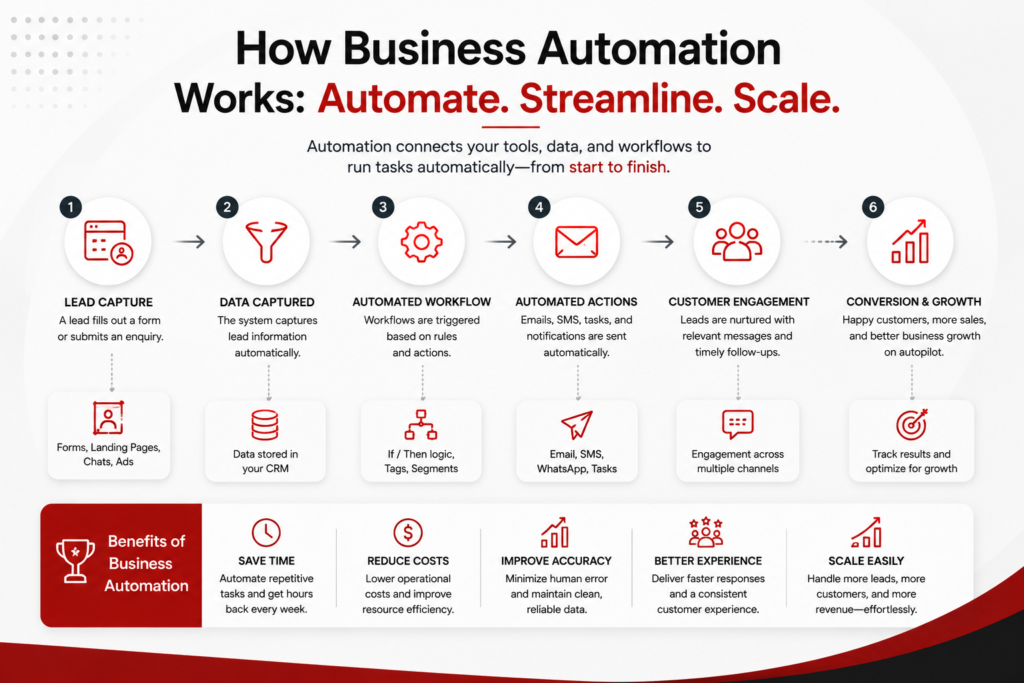
Modern businesses compete on speed, consistency, and customer experience. Manual processes often introduce delays, missed opportunities, and human error. Automation helps businesses:
- Save hours of repetitive work every week.
- Deliver faster responses to customers.
- Improve lead management.
- Reduce operational costs.
- Increase team productivity.
- Maintain consistent customer communication.
- Scale operations without significantly increasing administrative work.
For many businesses, automation becomes the foundation for sustainable growth.
| Business Area | Automation Example |
|---|---|
| Lead Management | Automatically capture, assign, and follow up with new leads. |
| Email Marketing | Send welcome emails, newsletters, and nurture campaigns automatically. |
| Appointment Booking | Allow customers to schedule meetings without manual coordination. |
| Customer Support | Use AI chatbots and automated responses for common enquiries. |
| Social Media | Schedule and publish content across multiple platforms automatically. |
| Review Management | Automatically request customer reviews after completed services. |
Is Business Automation Only for Large Companies?
Not at all. Automation is no longer limited to enterprise organizations. Today, small businesses, agencies, consultants, healthcare providers, real estate companies, trades, and professional service firms all use automation to simplify daily operations.
Cloud-based platforms have made automation affordable and accessible, allowing businesses of almost any size to automate marketing, sales, customer communication, and internal workflows.
Getting Started with Business Automation
The best place to begin is by identifying repetitive tasks that happen every day or every week. Ask yourself:
- Which tasks consume the most time?
- Which activities are repeated frequently?
- Where do mistakes commonly occur?
- Which processes require copying data between systems?
These are often the first processes that benefit from automation. Rather than trying to automate everything at once, businesses typically start with one workflow, measure the results, and expand automation over time.
Final Thoughts
Business automation isn’t about replacing employees, it’s about empowering them to work more efficiently. By automating repetitive tasks, businesses can reduce operational costs, improve customer experiences, and free their teams to focus on strategic work that drives growth.
Whether you’re a startup or an established company, implementing the right automation strategy can transform the way your business operates.
Frequently Asked Questions
What is business automation?
Business automation is the use of software and technology to automate repetitive tasks and workflows, helping businesses improve efficiency, reduce manual work, and save time.
What are examples of business automation?
Common examples include email marketing, CRM workflows, appointment scheduling, social media publishing, invoice generation, lead nurturing, and customer support automation.
Is business automation only for large businesses?
No. Businesses of all sizes can benefit from automation. Small businesses often use automation to streamline operations, improve customer communication, and reduce administrative work.
What are the benefits of business automation?
Business automation helps save time, reduce human error, improve productivity, deliver faster customer responses, lower operational costs, and support business growth.
How do I start automating my business?
Begin by identifying repetitive tasks that consume the most time. Automating processes such as lead management, follow-up emails, appointment booking, and customer communication often provides the quickest return on investment.
What tools are commonly used for business automation?
Businesses use platforms such as GoHighLevel, Zapier, Make, n8n, CRM systems, email marketing platforms, and AI-powered workflow tools to automate daily operations.
Ready to Automate Your Business?
At Auxth, we help businesses design and implement automation systems that streamline operations, improve customer experiences, and support long-term growth.
Book a Strategy Call to discover how automation can work for your business.
Related Articles
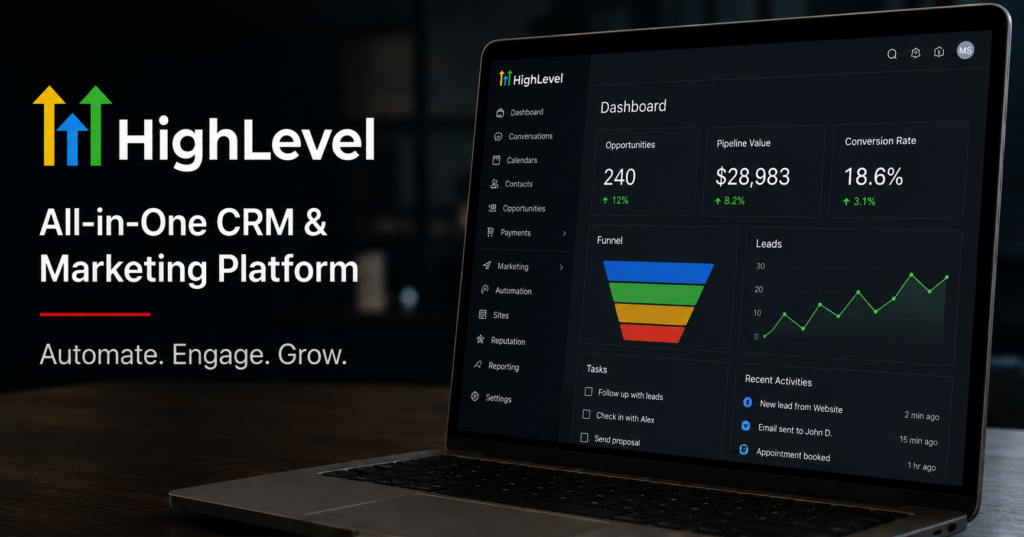
What Is GoHighLevel? The Complete Business Guide (2026)
Learn what GoHighLevel is, how it works, its key features, benefits, pricing, and why businesses use it to automate marketing, sales, and customer management.
10 GoHighLevel Features Every Growing Business Should Use in 2026
Discover the 10 most powerful GoHighLevel features that help businesses automate marketing, manage leads, build sales funnels, streamline customer communication, and improve efficiency, all from one all-in-one business platform.