
How Businesses Can Actually Implement AI Without Overcomplicating Operations
- Reading Time : 10 min
- Category : AI
- Updated Date : 01-09-2026

Table Of Content
- What Does AI Implementation in Business Actually Mean?
- Why Businesses Often Overcomplicate AI
- Start With Your Biggest Operational Bottleneck
- Build Around a Central CRM
- Practical AI Applications Businesses Can Start With
- Measure Business Outcomes, Not AI Activity
- Keep Humans in the Loop
- Final Thoughts
Introduction
Artificial intelligence has quickly moved from an emerging technology to a practical business tool. However, many businesses still struggle with one important question: where should we actually start?
The problem is rarely a lack of AI tools. There are now countless platforms promising automated content, intelligent chatbots, AI employees, predictive analytics, automated marketing, and faster workflows. The real challenge is deciding which processes should use AI and how to introduce it without creating another complicated layer of technology.
For most businesses, successful AI implementation does not begin with replacing everything or deploying dozens of AI tools at once. It begins by identifying repetitive processes, finding operational bottlenecks, and introducing automation where it can create a measurable improvement. A practical AI strategy should make the business simpler, faster, and easier to manage, rather than adding more software and more work.
What Does AI Implementation in Business Actually Mean?
AI implementation means integrating artificial intelligence into specific business processes to improve how work is performed. This could involve using AI to:
- Respond to common customer questions
- Qualify incoming leads
- Automate follow ups
- Assist with content creation
- Manage customer information
- Schedule appointments
- Analyze customer interactions
- Support sales teams
- Automate repetitive administrative tasks
- Connect different business systems through intelligent workflows
The important point is that AI does not need to control the entire business. Instead, businesses can identify individual processes where automation can remove unnecessary manual work while allowing employees to remain responsible for important decisions.
Why Businesses Often Overcomplicate AI
One of the biggest mistakes businesses make is adopting AI because it is popular rather than because they have identified a specific operational problem. A company may purchase multiple AI platforms, add chatbots to several channels, create complicated workflows, and connect numerous applications without first understanding how these systems should work together. This can result in:
- Duplicate customer data
- Disconnected software
- Confusing workflows
- Higher software costs
- More complicated management
- Poor employee adoption
- Difficulty measuring results
A better approach is to start with the business process rather than the technology. Ask a simple question:
What repetitive task is currently consuming time, creating delays, or causing leads and customers to be missed?
That question can reveal the best starting point for AI implementation.
Start With Your Biggest Operational Bottleneck
Before introducing AI, map the customer and operational journey. For example, consider what happens when a new prospect contacts a business.
Does the lead automatically enter a CRM?
Does someone receive an immediate notification?
Does the prospect receive a confirmation message?
Is the lead assigned to the correct salesperson?
Does the system automatically follow up if the prospect does not respond?
Can the business see exactly where that lead is in the sales pipeline?
If the answer to several of these questions is no, there may already be a significant opportunity for automation. Instead of implementing AI across the entire organization, the business can first improve this specific process.

Build Around a Central CRM
A practical AI strategy works best when customer information is centralized. A CRM can act as the central source of truth for customer records, communication history, appointments, opportunities, and sales pipeline activity. Auxth’s approach to business automation focuses on connecting CRM systems with communication channels, marketing infrastructure, sales processes, and automated workflows. This helps businesses reduce the fragmentation created when different teams rely on disconnected systems. For example, when someone submits a form, a properly connected system can:
- Capture the prospect’s information.
- Create or update the CRM contact.
- Assign the opportunity to the appropriate team member.
- Send an immediate confirmation.
- Move the opportunity into the relevant pipeline stage.
- Trigger an appropriate follow up sequence.
- Provide the sales team with visibility into the opportunity.
The objective is not simply automation. The objective is creating a connected customer journey.
Practical AI Applications Businesses Can Start With
AI becomes considerably more useful when applied to specific operational activities.
1. Lead Follow Up
One of the simplest opportunities is automating the first stages of lead communication. When a prospect submits a form or makes an inquiry, an automated workflow can acknowledge the inquiry and begin an appropriate follow up process. This reduces the risk of leads being forgotten while allowing sales staff to focus on conversations that require human involvement.
2. AI Chatbots and Virtual Assistants
Businesses frequently receive repetitive questions about services, pricing, availability, appointments, and general information. An AI chatbot or virtual assistant can handle suitable first level interactions around the clock. More complex inquiries can then be routed to a human team member. This creates a practical division of work:
AI handles repetitive interactions. Humans handle decisions, relationships, and complex conversations.
3. Appointment Scheduling
Scheduling can also be automated. Instead of exchanging multiple messages to find a suitable time, customers can use an integrated calendar to select an available appointment. Automated reminders can then help reduce missed appointments. This is particularly useful for service businesses, consultants, coaches, and other organizations that depend on booked consultations.
4. Marketing Automation
AI can support marketing workflows by helping businesses organize communication around customer behavior. For example, a prospect who downloads information but does not book a consultation can enter a nurturing sequence. A customer who completes a purchase can receive a follow up request. A dormant contact can enter a reactivation campaign. The important principle is that automation should be connected to a meaningful customer event.
5. Administrative Workflows
Many businesses still spend considerable time performing repetitive administrative activities such as transferring information between systems, updating records, organizing documents, or assigning tasks. Workflow automation can connect applications and remove unnecessary manual data entry. Auxth’s automation capabilities include workflow integrations using technologies such as GoHighLevel, n8n, Zapier, webhooks, and API connections.
A Simple AI Implementation Framework
| Business Area | Manual Problem | Practical AI or Automation Solution | Potential Benefit |
|---|---|---|---|
| Lead Management | Leads are manually entered and assigned | Automated CRM capture and routing | Faster response and better visibility |
| Customer Support | Repetitive questions consume staff time | AI chatbot or virtual assistant | Faster first response |
| Appointments | Staff manually coordinate bookings | Automated calendar scheduling | Less administrative work |
| Follow Ups | Leads are forgotten after initial contact | Automated email and SMS workflows | More consistent nurturing |
| Marketing | Campaigns require repetitive manual actions | Behavior based automation | More relevant communication |
| Administration | Data is copied between systems | Workflow and API integrations | Reduced manual data entry |
Do Not Automate Everything at Once
A common misconception is that successful AI adoption requires immediate large scale implementation. In reality, businesses can benefit from phased implementation. Start with the core CRM architecture. Then introduce basic communication triggers. Next, implement appointment scheduling or lead nurturing. Once these systems are stable, more advanced AI capabilities can be introduced.
This approach reduces disruption and makes it easier to identify whether each implementation is actually delivering value. Auxth’s website guidance similarly recommends starting with foundational CRM, communication, and scheduling capabilities before introducing more advanced AI bots and complex multi channel workflows.

Measure Business Outcomes, Not AI Activity
Another important principle is to measure business results rather than the number of AI tools deployed. A business should ask:
- Are leads being contacted faster?
- Are fewer inquiries being missed?
- Has administrative workload decreased?
- Are more appointments being booked?
- Are sales teams spending more time selling?
- Has customer response time improved?
- Are workflows easier to manage?
These measurements provide a much clearer picture of whether an AI implementation is successful. The goal is not to say that a business is “using AI.” The goal is to make the business perform better because AI is being used intelligently.
Keep Humans in the Loop
AI should not automatically replace every human interaction. Some processes require judgment, empathy, strategic thinking, negotiation, or relationship building. A strong implementation identifies where AI can assist employees rather than simply attempting to remove them from the process.
For example, an AI system might qualify an incoming lead and collect basic information before passing the opportunity to a salesperson. The salesperson then starts the conversation with useful context already available. This makes the employee more effective without removing the human element from the customer journey.
Final Thoughts
Implementing AI in business does not have to mean rebuilding the entire organization. The most effective approach is often much simpler: identify a real operational problem, automate the repetitive parts, connect the systems, measure the result, and expand gradually. Businesses can begin with practical applications such as CRM automation, lead follow ups, appointment scheduling, AI chatbots, marketing workflows, and repetitive administrative processes.
The technology should support the business strategy rather than become the strategy itself. AI creates the most value when it removes friction from existing operations and gives teams more time to focus on work that genuinely requires human expertise.
Frequently Asked Questions
What is AI implementation in business?
AI implementation is the process of integrating artificial intelligence into specific business activities to improve efficiency, customer communication, lead management, marketing, sales, or administrative operations.
Does a small business need AI?
Not every business needs advanced AI systems. However, businesses with repetitive tasks, large numbers of leads, frequent customer inquiries, or manual administrative workflows may benefit from targeted automation.
Where should a business start with AI?
Start by identifying a repetitive process that consumes significant time or creates operational problems. Lead management, follow ups, appointment scheduling, customer support, and administrative workflows are common starting points.
Can AI replace employees?
AI can automate certain repetitive tasks, but many business processes still require human judgment, communication, creativity, and relationship building. A practical strategy often uses AI to support employees rather than replace every human interaction.
How does AI work with a CRM?
AI and automation can work with a CRM to capture leads, organize customer information, trigger communications, manage pipeline activity, qualify prospects, schedule appointments, and automate follow ups.
Ready to Make AI Practical for Your Business?
At Auxth, we build customized AI and business automation systems that connect CRM, marketing, communication, sales, and operational workflows into a more efficient business engine. Instead of adding unnecessary technology, the focus is on identifying where automation can create measurable value and building a system around your actual business goals.
Want to identify where AI could save your business time and improve your operations?
Related Articles
What Is GoHighLevel? The Complete Business Guide (2026)
Learn what GoHighLevel is, how it works, its key features, benefits, pricing, and why businesses use it to automate marketing, sales, and customer management.
10 GoHighLevel Features Every Growing Business Should Use in 2026
Discover the 10 most powerful GoHighLevel features that help businesses automate marketing, manage leads, build sales funnels, streamline customer communication, and improve efficiency, all from one all-in-one business platform.
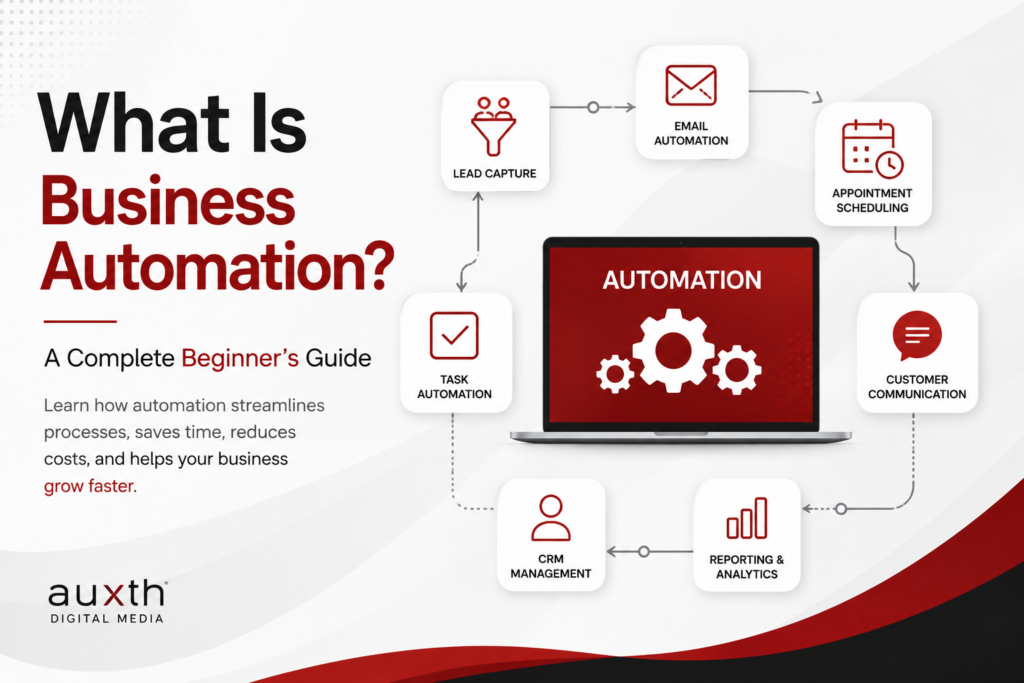
What Is Business Automation? A Complete Beginner's Guide
Discover how business automation helps companies streamline repetitive tasks, improve productivity, reduce errors, and create more efficient workflows.