
7 CRM Benefits That Can Transform Your Business Growth
- Reading Time : 10 min
- Category : Buisness Automations
- Updated Date : 06-08-2026
Table Of Content
- Better Lead Management
- Faster Customer Response Times
- Improved Customer Experience
- Increased Sales Productivity
- Better Business Insights
- Stronger Team Collaboration
- Scalable Business Growth
- Final Thoughts
Introduction
Customer expectations have never been higher. Businesses are expected to respond quickly, provide personalised experiences, and deliver consistent service across every interaction. Yet many companies still rely on spreadsheets, scattered emails, and manual follow-ups to manage customer relationships.
A Customer Relationship Management (CRM) system changes the way businesses operate. Instead of simply storing contact information, modern CRMs help organisations manage leads, automate repetitive tasks, improve communication, and make better business decisions using real-time data.
Whether you’re a small business looking to organise enquiries or a growing company aiming to scale operations, understanding the benefits of a CRM can help you build stronger customer relationships while increasing efficiency and revenue.
1. Better Lead Management
Every new enquiry is a business opportunity, but without a structured system, valuable leads can easily be forgotten or lost. A CRM captures leads from multiple channels, including websites, landing pages, social media, emails, and phone calls and stores them in one central location. This allows your team to:
- Track every enquiry
- Assign leads to team members
- Monitor sales progress
- Eliminate duplicate records
- Never miss follow-ups
Businesses with organised lead management often convert more enquiries into paying customers simply because no opportunity falls through the cracks.
2. Faster Customer Response Times
Research consistently shows that businesses responding quickly to enquiries are more likely to win new customers. A CRM helps by:
- Sending instant confirmation emails
- Automatically notifying sales teams
- Scheduling follow-up reminders
- Automating SMS responses
- Tracking customer communication history
Instead of manually checking emails throughout the day, your team receives immediate visibility into new opportunities.

3. Improved Customer Experience
Customers expect businesses to remember previous conversations, purchases, and preferences. With a CRM, every interaction is stored in one place. When a customer contacts your business, your team can instantly view:
- Previous enquiries
- Purchase history
- Quotes
- Support requests
- Appointments
- Internal notes
This creates a smoother, more personalised customer experience that builds trust and long-term loyalty.
4. Increased Sales Productivity
Sales teams spend a surprising amount of time on administrative work. Modern CRM platforms automate repetitive tasks such as:
- Data entry
- Follow-up scheduling
- Appointment reminders
- Pipeline updates
- Email sequences
By reducing manual work, your team spends more time building relationships and closing deals.
| Business Area | Without CRM | With CRM |
|---|---|---|
| Lead Follow-up | Manual reminders | Automated workflows |
| Customer Data | Scattered across tools | Centralised database |
| Sales Tracking | Manual updates | Real-time pipeline |
| Reporting | Spreadsheet reports | Live dashboards |
| Customer Experience | Inconsistent | Personalised and consistent |
5. Better Business Insights
One of the biggest advantages of a CRM is visibility. Instead of guessing how your business is performing, dashboards provide real-time insights into:
- Lead sources
- Conversion rates
- Sales performance
- Revenue trends
- Team productivity
- Customer retention
These insights allow businesses to make informed decisions based on data rather than assumptions.
6. Stronger Team Collaboration
Without a CRM, customer information often lives in individual inboxes or spreadsheets. A CRM creates a shared workspace where every authorised team member can access:
- Customer history
- Communication records
- Tasks
- Documents
- Notes
- Sales progress
This improves collaboration and ensures customers receive consistent service regardless of who they speak with.
7. Scalable Business Growth
As your business grows, manual systems become increasingly difficult to manage. A CRM provides the foundation for growth by supporting:
- Marketing automation
- Customer segmentation
- Workflow automation
- Sales pipelines
- Performance reporting
- Customer lifecycle management
Instead of hiring additional staff to manage repetitive tasks, businesses can automate many processes while maintaining a high level of customer service.

Final Thoughts
A CRM is no longer just a sales tool, it has become the central operating system for modern businesses. From improving customer experiences to increasing sales efficiency and providing valuable business insights, the right CRM helps organisations work smarter rather than harder. If your business is still relying on spreadsheets or disconnected tools, implementing a CRM could be one of the most impactful investments you make.
Frequently Asked Questions
What are the biggest benefits of using a CRM?
The biggest benefits include better lead management, faster customer responses, improved customer experiences, increased sales productivity, stronger collaboration, automation, and better reporting.
Can a CRM help increase sales?
Yes. A CRM helps businesses manage leads more effectively, automate follow-ups, and monitor sales pipelines, making it easier to convert prospects into customers.
Is a CRM worth it for small businesses?
Absolutely. Small businesses often benefit the most because a CRM helps organise customer information, streamline communication, and reduce manual work as the business grows.
How does a CRM improve customer experience?
A CRM gives teams instant access to customer history, enabling faster responses, personalised communication, and consistent service across every interaction.
Does a CRM automate business processes?
Yes. Most modern CRM platforms automate emails, SMS messages, lead assignments, appointment reminders, follow-ups, reporting, and other repetitive tasks.
Ready to unlock the full potential of a CRM?
Auxth helps businesses implement powerful CRM systems, automate customer journeys, and build scalable workflows that improve efficiency, customer satisfaction, and long-term growth.
Related Articles
What Is GoHighLevel? The Complete Business Guide (2026)
Learn what GoHighLevel is, how it works, its key features, benefits, pricing, and why businesses use it to automate marketing, sales, and customer management.
10 GoHighLevel Features Every Growing Business Should Use in 2026
Discover the 10 most powerful GoHighLevel features that help businesses automate marketing, manage leads, build sales funnels, streamline customer communication, and improve efficiency, all from one all-in-one business platform.
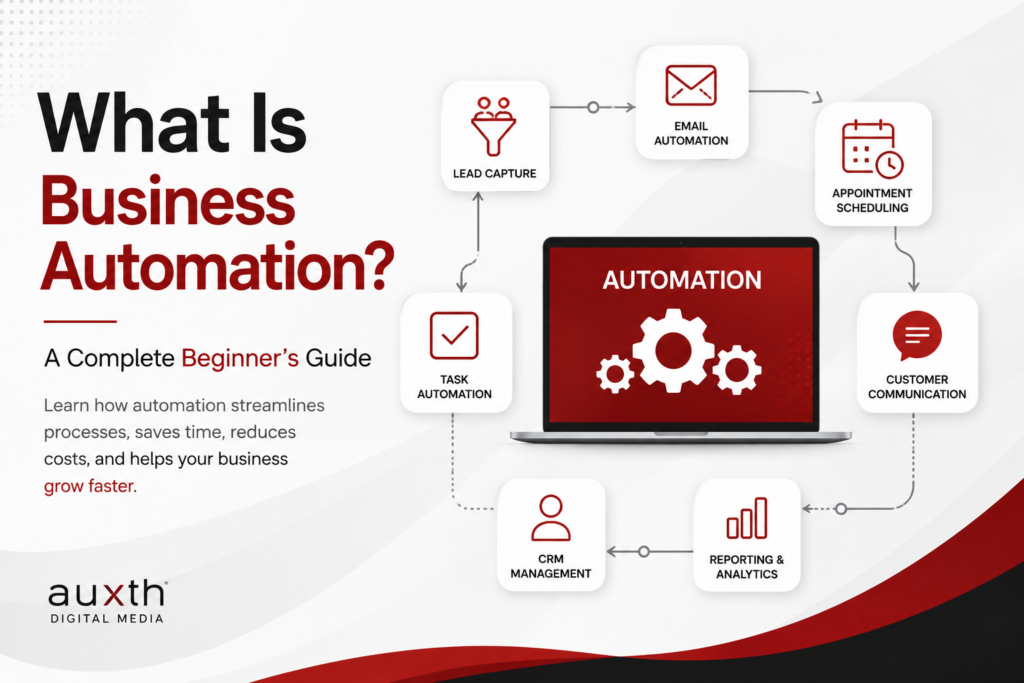
What Is Business Automation? A Complete Beginner's Guide
Discover how business automation helps companies streamline repetitive tasks, improve productivity, reduce errors, and create more efficient workflows.